
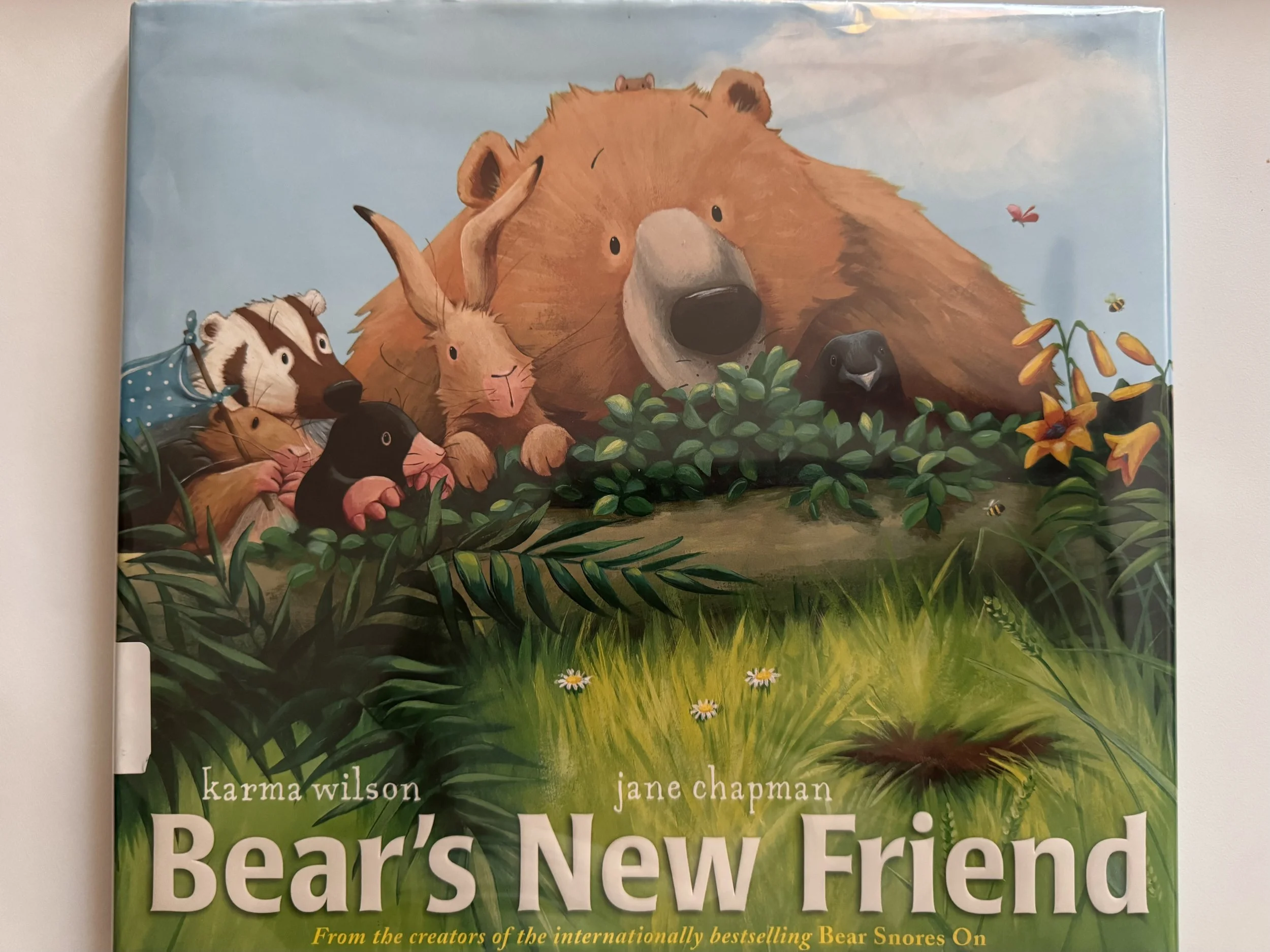
Some activities come together so naturally that by the end, you can't quite remember which activity flowed into the next. That's exactly how our latest Talk and Tinker session felt - 45 minutes of movement, music, and water play, all inspired by the sweet story Bear's New Friend.
Starting with a Story, Not a Read-Aloud
Here's the thing: I never actually read Bear's New Friend cover to cover during class. Instead, I kept the book close by the entire time, dipping into it whenever we needed inspiration - a page to peek at, an animal to name, a scene to act out. This "story as a toolbox" approach worked beautifully for our mixed-age group of toddlers and preschoolers, who have wildly different attention spans and interests.
What surprised me most was how the kids treated the book itself as an activity. Whenever it wasn't in my hands, it was in theirs. They flipped through the pages on their own, pointing at animals and naming their actions, completely unprompted. That kind of independent engagement is exactly what we hope for in early literacy: the book becomes a friend, not a lesson.
Not only were they interested in Bear’s New Friend, the kids naturally went to the story corner of the classroom we were using and picked out books that had animals in them. One child even “read” a story book to me!
Movement: Becoming the Animals in the Story
Since Bear's New Friend is full of animal characters, movement was an easy and joyful place to start. We:
Enacted the animals' movement patterns - letting each toddler interpret how a bear might lumber, a rabbit might hop, or a bird might flutter
Practiced "peering" - crouching down and peeking into boxes and bags, just like the characters in the book do when they're searching for a new friend
Went on a hidden-animal hunt - using that same peering motion to discover toy animals tucked away around the room
This last one turned into the perfect bridge into our music activity.
Music: A Made-Up Song and an Old Favorite
To power our hidden-animal hunt, I picked up a hand drum and used its steady rhythm to underscore a song I made up on the spot: "Where is [animal name]?" Each verse became a call-and-response as we searched together, the drumbeat building a little suspense before the big reveal of each hidden creature.
Remember I shared earlier that the children started picking up and “reading” other animal books - these were mostly about farm animals. As the children named the animals and shouted out the animal sounds, they were clearly eager to expand the game beyond the book's cast of characters. Rather than redirect them, I followed their lead and we broke into a round of "Old MacDonald Had a Farm." Even the child that needed to move around the class and seemed disengaged, participated fully and sang along with us! It was a nice reminder that toddlers are often the best co-designers of a lesson plan, and that a little flexibility can turn a tangent into one of the most memorable parts of class.
Water Play: Recreating the Waterhole
We saved the messiest, and most popular activity for the end: recreating the waterhole scene from the book. Using a plastic tub, the kids took turns pouring water in with a small bowl, watching the "waterhole" slowly fill up. Once it did, we brought in toy animals for a good scrub, washing them off in the water just like the animals in the story might gather at a waterhole.
This activity tied together everything we'd done - the animals from our movement games and hidden-animal hunt got a second life as bath-time companions, and the tactile, sensory nature of pouring and splashing gave the toddlers a calm, absorbing way to wind down the class.
What Made This Class Work
Looking back, a few things stood out:
Keeping the book present but not prescriptive let it act as a living reference rather than a rigid script
Layering movement, music, and water play around a single story gave the whole class a sense of narrative continuity, even without a formal read-aloud
Following the toddlers' cues, like their sudden interest in farm animals, made the class feel collaborative rather than curated
I hope you take inspiration from these activities. You could do some of these activities with your child, or even ask your child to read the book to you! And don't be afraid to let the book just... sit there. Sometimes the best literacy moment is watching a toddler flip through the pages on their own terms.